
 Train Your Brain
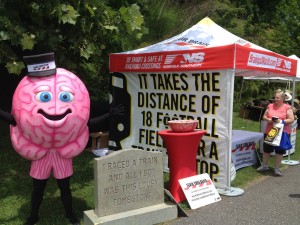
Did you know that about every three hours, a person or vehicle is hit by a train? What a startling statistic! To help combat risky moves on and around railroad tracks, Norfolk Southern began a public safety campaign titled “Train Your Brain” in 2007. The campaign features a happy, pink walking brain named Brainy, who is intended to be a walking illustration for citizens to remember railroad safety at all times. Each year his efforts focus on a different area of the United States, and this summer he has traveled about North and South Carolina sharing safety facts and tips.
Here are some Startling Stats:
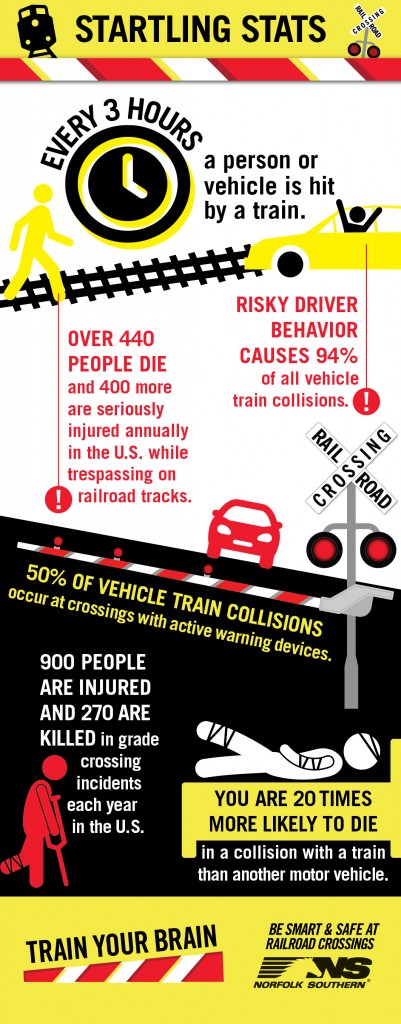
- Over 440 people die and 400 more are seriously injured annually in the U.S. while trespassing on railroad tracks.
- You should never walk on or across the tracks except at designated public crossings with either a crossbuck, flashing red lights or a gate. If you cross at any other place, you are trespassing illegally and can be ticketed or fined. It’s also highly dangerous.
- Do not hunt, fish or bungee jump from railroad trestles. There is only enough clearance on the tracks for a train to pass. Trestles are not meant to be sidewalks or pedestrian bridges.
- Grade crossing incidents each year cause 900 injuries and another 270 deaths in the U.S. Risky driver behavior causes 94 percent of all vehicle train collisions.
- Trains and cars don’t mix. Never race a train to the crossing – even if you tie, you lose.
- If your vehicle ever stalls on a track with a train coming, get out immediately and move quickly away from the tracks in the direction from which the train is coming.
- Fifty percent of vehicle train collisions occur at crossing with active warning devices.
- If you see a train coming, wait! Flashing lights or a lowering gate means a train is approaching. Do not proceed until the gates go completely up and the lights go off. It is illegal to go around lowered gates, whether in a vehicle, on a bike or on foot.
- You are 20 times more likely to die in a collision with a train than another motor vehicle.
- It takes the average freight train traveling at 55 mph more than a mile—the length of 18 football fields—to stop, so a locomotive engineer who suddenly sees someone on the tracks will likely be unable to stop in time.
- Do not cross the tracks immediately after a train passes. A second train might be blocked by the first. Trains can come from either direction. Wait until you can see clearly around the first train in both directions.
It’s important to encourage drivers of all ages to learn railroad safety. To learn more about Norfolk Southern’s “Train Your Brain” program and view more driver tips, please visit www.brainysworld.com or www.facebook.com/brainysworld.